From Pull Requests to Prompt Requests

I recently tweeted about something I see coming: maintainer overflow (X).
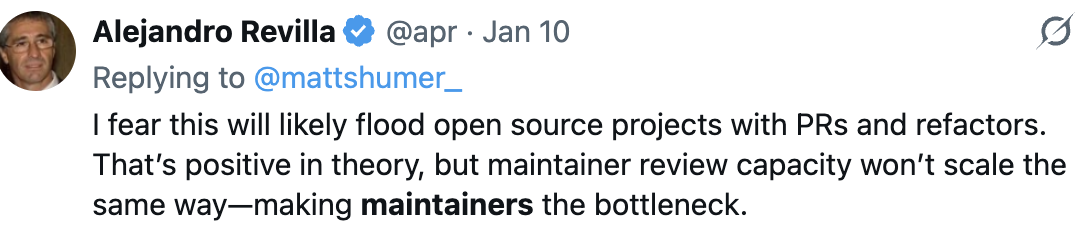
I have been the maintainer of the jPOS project for a quarter of a century now. Over the years, pull requests of very different quality have come and gone.
The good ones—the ones that truly move the project forward—usually bubble up from discussions on the mailing list, Slack, or at our meets. Although we don’t have a formal process—we are not that big—they tend to originate from some kind of JEP, a jPOS Enhancement Proposal. There is context. There is discussion. There is intent.
From time to time, we get the smart developer blasting 100 projects with the same trivial scripted PR—changing a StringBuffer to a StringBuilder, or replacing a Hashtable with a HashMap. Those changes could be welcome, if not for the typical tone that reads like:
“Dramatically improve the performance of this project with my genius discovery of this new Java class.”
I usually respond with a few questions. And if the refactor includes more than a handful of lines, we need to talk about a CLA. That’s often when the silence begins.
These developers remind me of my old days in ham radio, when the Russian Woodpecker radar would sweep across the band—pahka pahka pahka pahka pahka—blasting your headphones in the middle of the night, and then disappearing.
I believe these kinds of PRs will soon arrive in the hundreds. We already see “CRITICAL” ones created by developers trying to collect internet karma by prompting their AI agent with a junior-level request and submitting whatever comes out.
Let me be clear: all improvements are welcome.
But well-established projects, running in production at very large companies and handling literally billions of dollars daily—like jPOS—require an extremely cautious approval process.
We follow PCI requirements. ISO/IEC 27001. ISO/IEC 20243 supply-chain assessments. We must be careful.
Analyzing a PR produced by AI is an order of magnitude more complex than prompting your own AI to explore the same idea. When you prompt it yourself, you can walk through the plan, tweak it, ask questions about side effects, keep the broader roadmap in mind, inspect the generated diffs, and request tests where you fear an edge case could beat you—or where you remember it already did.
Reviewing a blind AI-generated PR reverses that process. The maintainer has to reconstruct the intent, guess the prompt, and audit the reasoning after the fact. That is expensive.
It is much easier to receive a prompt—possibly with a detailed plan and some sample tests—than to receive a finished pull request.
So here is a proposal.
Instead of sending Pull Requests, consider sending Prompt Requests.
A Prompt Request describes:
- The problem you want to solve.
- The context within jPOS.
- The risks and side effects you anticipate.
- The prompt you used (or propose to use).
- The expected outcome, including tests.
That allows the maintainer to evaluate the reasoning before evaluating the diff. It allows iteration before code lands. It allows us to align with the roadmap, compliance requirements, and architectural direction.
In many cases, the maintainer can then take the prompt, refine it, test it with different models, and generate the final implementation under controlled conditions.
Or decide that it’s not the right change.
I'm basically saying: Give it here—I’ll do it myself, genius. :)